ACF Repeater vs Group: Performance & Use Cases
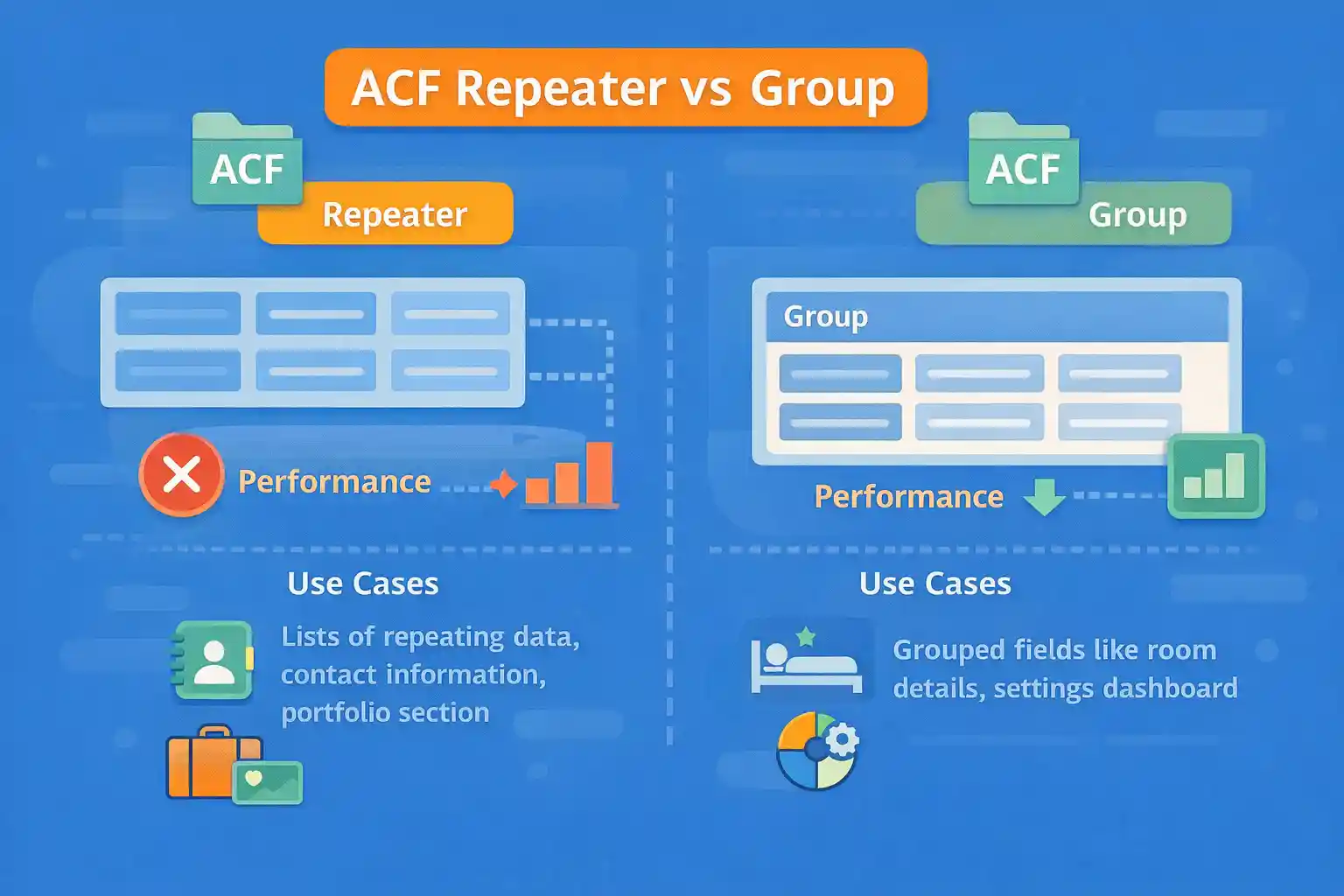
Advanced Custom Fields (ACF) offers two popular ways to organize related fields: Repeater and Group. They may look similar in the admin UI, but their data structure, performance characteristics, and ideal use cases are very different.
This article explains the differences clearly, with a focus on performance, scalability, and real-world usage, so you can choose the right field type from the start.
Quick Conceptual Difference
- Group: A single logical object containing multiple subfields
- Repeater: A list (array) of the same field set, repeated multiple times
If you think in data terms:
- Group = one structured record
- Repeater = multiple rows of the same structure
ACF Group Field Explained
A Group field bundles several related fields together, but it always exists as one unit.
Typical Use Cases
- Hero section settings (title, subtitle, image, CTA)
- SEO meta (custom title, description, noindex flag)
- Author profile (name, role, avatar)
- Settings-like field collections
How the Data Is Stored
Each subfield is saved as its own post meta entry, using a prefixed key.
Example:
hero_titlehero_imagehero_button_url
No loops. No indexes. Just simple meta values.
Template Usage
<?php
$hero = get_field( 'hero' );

if ( $hero ) :
?>
  <h1><?php echo esc_html( $hero['title'] ); ?></h1>
  <p><?php echo esc_html( $hero['subtitle'] ); ?></p>
<?php endif; ?>
ACF Repeater Field Explained
A Repeater field allows editors to add any number of rows, each with the same subfields.
Typical Use Cases
- FAQs
- Feature lists
- Timelines / steps
- Pricing rows
- Testimonials
How the Data Is Stored
This is where complexity increases.
For each row, ACF creates multiple meta entries with indexed keys.
Example (2 rows):
faq_0_questionfaq_0_answerfaq_1_questionfaq_1_answer
The total number of meta rows grows quickly as content scales.
Template Usage
<?php if ( have_rows( 'faq' ) ) : ?>

  <section class="faq">
    <?php while ( have_rows( 'faq' ) ) : the_row(); ?>
      <h3><?php echo esc_html( get_sub_field( 'question' ) ); ?></h3>
      <p><?php echo esc_html( get_sub_field( 'answer' ) ); ?></p>
    <?php endwhile; ?>
  </section>

<?php endif; ?>
Performance Comparison (What Actually Matters)
Group Field Performance
- Lightweight
- Predictable number of meta queries
- Easy to cache
- Scales well on large sites
From a performance perspective, Group fields are almost always safe.
Repeater Field Performance
- Meta rows increase linearly with content size
- More memory usage on large repeaters
- Nested repeaters amplify the problem
Repeater fields are fine for small-to-medium datasets, but they can become expensive if abused.
When Repeater Fields Become a Problem
- Dozens or hundreds of rows per post
- Nested repeaters (repeater inside repeater)
- Using repeaters as a database replacement
- Heavy querying across many posts
If you hit these cases, consider:
- Custom Post Types instead of repeaters
- A dedicated table or external data source
- Reducing field depth
SEO and Content Structure Considerations
Neither field type is inherently better or worse for SEO. What matters is how you output the content.
- Group fields work well for structured, above-the-fold content
- Repeater fields are ideal for semantic lists (FAQs, steps)
For FAQ schema or structured data, repeaters are often the natural choice — but keep them lean.
Editor Experience (Often Overlooked)
Group Fields
- Clear and predictable
- Low risk of content inconsistency
- Great for non-technical editors
Repeater Fields
- Flexible but easier to misuse
- Editors may add too many rows
- Requires content guidelines
Tip: If editors don’t need “add unlimited rows”, don’t give them a repeater.
Common Anti-Patterns
- Using a repeater for a fixed set of fields (should be a group)
- Using nested repeaters for layout building
- Putting global settings into repeaters
- Querying repeater subfields across many posts
Decision Guide
- Is the number of items fixed? → Group
- Does the editor need to add/remove rows? → Repeater
- Is performance critical at scale? → Prefer Group
- Is this a list of similar content blocks? → Repeater
Can You Combine Them?
Yes — and this is common.
- Repeater for a list (e.g. features)
- Group inside each row for internal structure
Just avoid deep nesting and uncontrolled growth.
Conclusion
ACF Group and Repeater fields solve different problems. Group fields are structured, fast, and predictable. Repeater fields are flexible and powerful — but should be used intentionally.
Key takeaway:
If the content is “one thing”, use a Group. If it’s “many of the same thing”, use a Repeater — and keep it lean.
🎨 Want to learn more? Visit our WordPress Customization Hub for tips and advanced techniques.